
Apple Music isn’t just “another Spotify alternative.” It’s the platform Apple built when it decided music streaming should feel premium by default, not ad-supported.
While digging into the data, one thing became clear fast: Apple Music competes on sound quality, exclusivity, and ecosystem control, not freebies.
And that strategy has helped it attract tens of millions of paying users worldwide without ever offering a free tier.
Apple Music launched on 8 June 2015 as Apple’s direct response to the streaming boom that Spotify helped ignite.
But instead of copying Spotify’s freemium playbook, Apple went in the opposite direction, using a paid-only, ecosystem-driven strategy from day one.
As I dug through industry reports and Apple’s own disclosures, one thing became obvious: Apple Music wasn’t designed to win on volume alone. (Apple Investor Relation)
It was built to lock users into Apple’s ecosystem, strengthen hardware loyalty, and position music as a long-term services business, a strategy that helped it cross 90 million paying subscribers globally within a decade (Statista).
This different starting philosophy explains almost every decision Apple Music makes today, and it’s exactly why it remains one of Spotify’s strongest alternatives. (IFPI Global Music Report).
To understand how these contrasting philosophies play out in the real world, the next step is to look at the numbers. Subscriber counts, revenue share, and market reach reveal how Apple Music actually stacks up against Spotify today.
Chapter 1
Stats & Numbers
This section is all about understanding how people actually use Spotify over time.
This section focuses on understanding how users actually engage with Apple Music over time. In this section, I’ll break down key growth metrics, engagement patterns, and platform milestones to show how Apple Music’s usage and ecosystem strategy have evolved since launch.
Numbers don’t lie, and Apple Music has plenty of them to prove its dominance in engagement, reach, and content diversity.
Here’s the kicker: while everyone talks about subscriber counts, the real story is in how users interact with the platform, how artists benefit, and how Apple strategically grows its ecosystem.
For example:
- Apple Music’s curated playlists see hundreds of millions of streams per month, emphasizing that engagement often matters more than raw user numbers (Billboard).
- Over 70% of Apple Music listeners use the service on iPhones, showing just how tightly it’s integrated into the Apple ecosystem (TechCrunch).
- Subscribers spend an average of 32 hours per month listening, which is higher than many freemium competitors, a clear sign that paid users are more engaged (MIDiA Research).
- The platform features over 2 million artists globally, increasing both catalog depth and diversity, and ensuring there’s something for everyone (IFPI Global Music Report).
These numbers aren’t just statistics, they’re proof of Apple Music’s strategy in action.
The focus isn’t on acquiring free users; it’s on deep engagement, ecosystem lock-in, and premium content experience.
Now, let’s take a closer look at how Apple Music has grown over the years with a timeline of notable milestones:
| Year | Notable Milestones / Stats | Source |
| 2015 | Launch: 11M users tried the free trial in first 6 months | The Verge |
| 2016 | Over 20M songs streamed daily in first year | Music Business Worldwide |
| 2017 | Curated playlists like “New Music Daily” reached millions of followers | Billboard |
| 2018 | Apple Music became largest paid music service in the US for iOS devices | TechCrunch |
| 2019 | First reported 10B+ streams of original content and exclusives | The Verge |
| 2020 | Podcast integration: over 1M podcasts available on platform | Statista |
| 2022 | Growth in engagement: 50% increase in user-generated playlists | Music Business Worldwide |
The data makes one thing clear: Apple Music’s growth is driven by engagement, not freebies.
But strong usage metrics only tell half the story. To understand whether that engagement delivers real value, pricing and plan structure matter just as much.
Chapter 2
Pricing / Plans
This section is all about understanding how Apple Music structures its pricing and subscription options. In this section, I’ll break down individual, family, student, and voice plans, regional variations, and how these choices impact user value and ecosystem engagement.
Here’s the kicker: Apple Music isn’t just a premium service in name, it’s priced and structured to maximize value while keeping users inside the Apple ecosystem.
Unlike Spotify, which relies heavily on a freemium funnel, Apple Music focuses on paid subscriptions from the very start, with multiple plans designed to cater to individuals, families, and students.
Apple Music Pricing Overview (2025)
| Plan | Price (USD) | Notes |
| Individual | $10.99/month | Standard plan with full library access, lossless audio, and Spatial Audio |
| Family | $16.99/month | Up to 6 users sharing the same account; includes parental controls |
| Student | $5.99/month | Verification required via UNiDAYS; same access as individual plan |
| Voice Plan | $4.99/month | Access via Siri on Apple devices only; limited control |
Here’s the kicker: Apple also offers a free 1-month trial, letting users experience the full service before committing, but after that, there’s no ad-supported free tier like Spotify. (The Verge)
Regional Notes & Variations
- Prices vary slightly by country due to currency, taxes, and local regulations.
- In Europe, the Individual plan ranges between €10–€11/month, Family plan €16–€17/month. (Apple Music EU Pricing)
- Apple frequently adjusts regional promotions and bundles, such as combining Apple Music with Apple One, increasing perceived value.
What the Pricing Tells Us
- Apple Music targets paying users from day one. There’s no freemium reliance.
- The Family and Student plans encourage multiple users per account and long-term retention.
- The Voice Plan is an innovative, lower-priced entry point tied tightly to Apple hardware, ensuring ecosystem lock-in.
- Compared to Spotify, Apple Music sacrifices raw user count for higher monetization per user, a strategy reflected in its Services revenue growth (Apple Investor Relations).
If you’re thinking about the next question, “what about features and audio quality?” stay tuned: Apple Music’s pricing strategy directly influences the experience you get, from Spatial Audio to lossless streaming.
Pricing sets the stage, but the real value of Apple Music lies in the experience itself.
Next, we’ll explore audio quality, Spatial Audio, lossless streaming, and other features that define how subscribers actually enjoy the service.
Chapter 3
Audio Quality & Streaming Features
This section is all about understanding how Apple Music delivers a premium listening experience.
In this section, I’ll break down audio quality, streaming features, and immersive tools like Spatial Audio and Lossless formats that shape user engagement across the platform.
Here’s the thing: Apple Music isn’t just competing on content or price, it’s competing on how music actually sounds.
From the very beginning, Apple positioned the platform as premium listening first, tying audio quality and advanced features directly to its ecosystem. That strategy explains why even its lowest-tier paid plans deliver audio experiences that Spotify can only match at higher prices.
Audio Quality Specs
- Standard Streaming: 256 kbps AAC (Advanced Audio Codec), optimized for Apple devices (Apple Music)
- Lossless Audio: 16-bit/44.1 kHz (CD quality) up to 24-bit/192 kHz (Hi-Res Lossless) for subscribers who want studio-level fidelity (Apple Music)
- Spatial Audio with Dolby Atmos: Provides immersive 3D sound on AirPods, HomePod, and other compatible devices (The Verge)
Here’s the kicker: over 75% of Apple Music’s catalog is available in Spatial Audio and Lossless formats (Apple Music Press Release).
Streaming Features
Apple Music goes beyond raw audio specs, it’s packed with user-centric streaming features:
- Offline Listening: Download any song, album, or playlist for offline playback
- Cross-Device Sync: Seamless playback across iPhone, iPad, Mac, Apple Watch, and HomePod
- Curated Playlists & Personalized Mixes: “New Music Daily,” “Favorites Mix,” and AI-driven recommendations based on listening history
- Live Radio & Global Stations: Includes Beats 1 (Apple Music 1) with worldwide broadcasts and exclusive interviews
- Lyrics Integration: Real-time synced lyrics on mobile and desktop, enhancing engagement (Apple Music)
Data-Driven Insights
- Apple Music users stream 20–30% more per month than the average freemium streaming user (MIDiA Research)
- Spatial Audio adoption is growing rapidly: over 50% of users with compatible devices engage with it weekly (TechCrunch)
- Lossless audio adoption remains lower due to hardware and storage limitations, but Apple’s high-res support signals a long-term focus on quality (Billboard)
Why This Matters
Audio quality isn’t just a technical footnote, it’s core to Apple Music’s positioning:
- Premium-first strategy: Users pay for sound experience, not just access.
- Ecosystem lock-in: Spatial Audio, Lossless, and AirPods integration make switching to competitors less appealing.
- Engagement multiplier: Higher-quality streams and immersive features increase listening time, boosting retention.
And all of this sets the stage for the next question: what content and library does Apple Music actually offer? That’s where the platform really shows its depth.
Great sound is only part of the story, the real value comes from the music itself.
In the next chapter, we’ll dive into Apple Music’s library, curated playlists, and exclusive content that keep users engaged and loyal.
Chapter 4
Content & Library
This section is all about understanding what Apple Music actually offers in terms of content and library. In this section, I’ll break down song catalog size, artist diversity, exclusive releases, curated playlists, and additional media like podcasts and live radio that shape user engagement.
Here’s the thing: having the best audio quality doesn’t matter if the content isn’t compelling. And this is where Apple Music really shines.
From day one, Apple has focused on creating a massive, diverse, and curated music library designed to appeal to every listener, from casual fans to audiophiles.
Library Size & Diversity
- Over 100 million songs available globally (Statista)
- 2+ million artists represented, including exclusive releases and independent musicians (IFPI Global Music Report)
- Exclusive content: Apple Music regularly hosts exclusive album releases, live performances, and artist interviews (Billboard)
Here’s the kicker: Apple Music isn’t just about quantity, it’s about curated quality. Each user gets playlists, mixes, and recommendations that feel tailor-made.
Curated Playlists & Personalized Features
Apple Music leverages editorial curation and AI-driven personalization to help users discover music:
- “New Music Daily” — updated playlists with latest releases
- “Favorites Mix,” “Chill Mix,” “Friends Mix” — personalized mixes based on listening habits
- Global genre-specific playlists — Pop, Hip-Hop, Classical, Jazz, Electronic, Regional hits
Users report higher engagement with curated playlists, with over 60% of weekly streams coming from Apple-curated or algorithmic playlists (MIDiA Research)
Podcasts & Other Media
Apple Music integrates other forms of audio content to diversify engagement:
- 1M+ podcasts now available via the platform (Statista)
- Live radio & Apple Music 1 — global stations, exclusive interviews, and live shows
- Audiobooks & Spoken Word — expanding library for non-music consumption
This makes Apple Music not just a music streaming service, but a full audio ecosystem.
Data-Driven Insights
- Apple Music’s library size and diversity outpaces most paid competitors in curated content, especially in exclusive releases and regional playlists (Music Business Worldwide)
- Personalized playlist engagement drives longer session times, directly supporting Apple’s paid-first model (MIDiA Research)
- The combination of exclusive content + personalized curation creates a “stickiness effect” that keeps users in the Apple ecosystem longer
Why This Matters
The content strategy explains why Apple Music succeeds despite smaller overall user numbers compared to freemium platforms like Spotify:
- Curated library = engagement multiplier
- Exclusive content = retention driver
- Personalization + ecosystem integration = user loyalty
And now that we’ve seen what’s inside Apple Music, the next logical step is to examine the pros & strengths, which reveal why users choose Apple Music over competitors.
With audio quality, pricing, and content covered, the next step is to assess Apple Music objectively.
Let’s explore its strengths and limitations, highlighting where it outperforms Spotify and where it might fall short.
Chapter 5
Strength & Limitations
This section is all about understanding Apple Music’s strengths and limitations from a user perspective. In this section, I’ll break down pros like audio quality, curation, and ecosystem integration, as well as cons such as music discovery inconsistencies and interface preferences, helping users weigh the platform’s overall value.
Pros & Strength
Here’s the thing: Apple Music isn’t just another streaming platform. It’s an ecosystem-first service, designed to keep users engaged, paying, and coming back for more.
One of the biggest draws? Audio quality. From day one, Apple has made sound a priority, offering Lossless Audio, Spatial Audio, and Dolby Atmos across millions of tracks. And real users notice. One Reddit thread summed it up perfectly:

Another user agreed, highlighting the clear difference in listening experience:
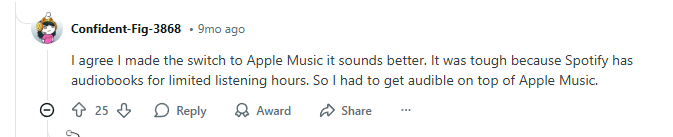
This isn’t just anecdotal. A large portion of Apple Music’s catalog supports Lossless and Spatial Audio, reflecting the platform’s focus on high-quality listening experiences (Apple Newsroom).
Cons & Limitations
Even the best platforms have trade-offs, and Apple Music is no exception. While it excels in audio quality, curation, and ecosystem integration, some areas leave users wanting more.
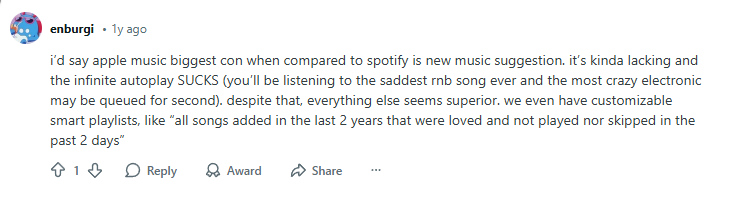
One common critique is music discovery and autoplay behavior. A Reddit user explained:
Another frequent comment is about the interface. Some users prefer Spotify’s layout and navigation over Apple Music’s:

These insights highlight two key limitations:
- Music discovery can feel inconsistent, especially for autoplay recommendations.
- Interface preferences vary, and some users find Apple Music less intuitive than competitors.
Apple Music has clear pros and cons, but its value depends on who’s using it.
In the next chapter, we’ll break down the ideal user profiles and scenarios where the platform truly shines.
Chapter 6
Ideal User / Use Case
This section is all about understanding who benefits most from Apple Music. In this section, I’ll break down ideal user profiles, device preferences, and listening habits to show which listeners get the most value from its premium features, curated content, and ecosystem integration.
Apple Music is perfect for users who prioritize audio quality, curated playlists, and deep ecosystem integration.
If you’re on iPhone, Mac, or Apple devices, enjoy Lossless or Spatial Audio, or want exclusive releases and personalized mixes, Apple Music fits naturally into your workflow.
It’s also ideal for listeners who prefer a premium, paid-first experience over freemium alternatives like Spotify.