
In today’s episode I am going to put a shadow on “Spotify Annual Usage” stats.
According to Google Spotify is acquiring almost 713 Million users globally which is 8.8% of world popularity and with an estimate of 13% of internet users which is huge making it the most dominant music streaming platform.
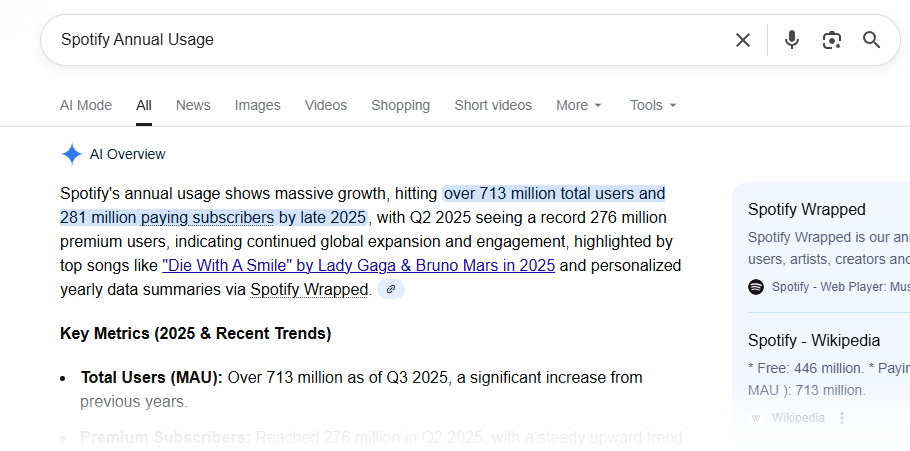
Even these numbers are also confirmed by Spotify itself in their Q3 2025 Update.
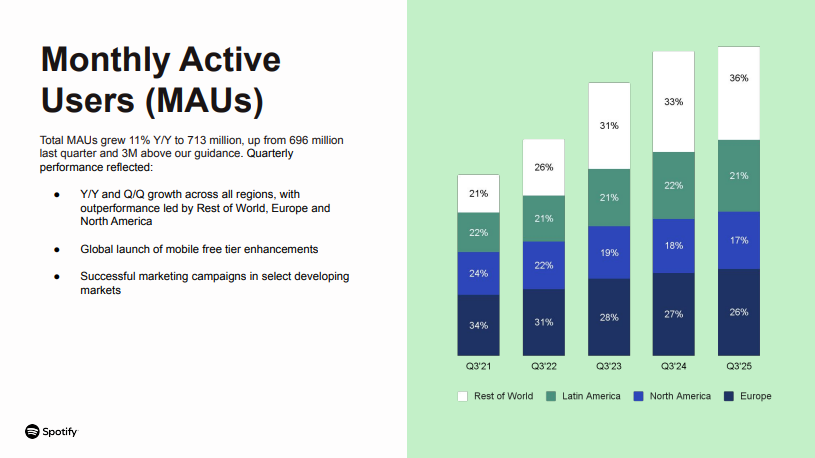
According to Backlinko, out of Spotify’s 713 million users, 281 million are paying subscribers. With a library of over 100 million tracks and around 7 million podcasts, Spotify commands a 31.7% share of the global music streaming market. This dominance helped the platform generate €15.67 billion in revenue in 2024.
For better understanding i am going to split this guide into different chapters:
- Spotify Annual Usage Data (2015–2025)
- Spotify Growth Chart 2015–2025
- Spotify Regional Market Share
- Spotify vs Competitors (2025)
- Spotify Trend Forecast 2026
Let’s begin with the first chapter.
Chapter 1
Spotify Annual Usage Data (2015–2025)
This section is all about understanding how people actually use Spotify over time.
In this section, I’ll break down annual usage data from 2015 to 2025 and show you how listening habits, engagement levels, and user behaviour have evolved across the platform.

If you want to understand how big Spotify has become, I’d suggest starting with the data, not opinions.
That’s why I’ve laid out Spotify’s multi-year user growth in the table below. It tracks the platform’s total Monthly Active Users (MAUs) across every quarter, combining both free listeners and Premium subscribers.
Total MAUs = Free users + Premium users
Once you scan the table, a clear pattern emerges.
Back in Q1 2015, Spotify had 68 million active users. At the time, it was growing fast, but it still felt like a promising streaming platform rather than a global giant.
Just one year later, by Q1 2016, that number had already climbed to 96 million. Growth wasn’t slowing. It was compounding.
By Q4 2017, Spotify crossed 160 million MAUs, marking the point where the platform shifted from rapid expansion to true global scale.
The next phase is where things get interesting.
In Q4 2019, Spotify reached 271 million monthly users. Even during the uncertainty of 2020, the platform kept adding listeners, finishing Q4 2020 with 345 million MAUs.
That momentum carried straight through the following years.
By Q4 2021, Spotify had 406 million active users.
By Q4 2022, it surged to 489 million.
Crossing half a billion wasn’t a surprise. It was inevitable.
That milestone arrived in Q1 2023, when Spotify reported 515 million MAUs. And the pace didn’t ease. The platform closed Q4 2023 with 602 million users, then pushed further to 675 million by Q4 2024.
As of Q3 2025, Spotify stands at 713 million monthly active users worldwide.
When you look at the table as a whole, the takeaway is simple.
Spotify didn’t grow through one breakout year or a short-term trend. It scaled consistently, quarter after quarter, for over a decade. And that kind of sustained growth is what turns a product into a category leader.
Use the table to see the progression yourself. The numbers tell the story better than any headline ever could.
Total MAUs = Monthly Active Users (Free + Premium)
| Quarter | Active Users |
| Q1 2015 | 68M |
| Q2 2015 | 77M |
| Q3 2015 | 82M |
| Q4 2015 | 91M |
| Q1 2016 | 96M |
| Q2 2016 | 104M |
| Q3 2016 | 113M |
| Q4 2016 | 123M |
| Q1 2017 | 132M |
| Q2 2017 | 138M |
| Q3 2017 | 149M |
| Q4 2017 | 160M |
| Q1 2018 | 157M |
| Q2 2018 | 180M |
| Q3 2018 | 191M |
| Q4 2018 | 207M |
| Q1 2019 | 217M |
| Q2 2019 | 232M |
| Q3 2019 | 248M |
| Q4 2019 | 271M |
| Q1 2020 | 286M |
| Q2 2020 | 299M |
| Q3 2020 | 320M |
| Q4 2020 | 345M |
| Q1 2021 | 356M |
| Q2 2021 | 365M |
| Q3 2021 | 381M |
| Q4 2021 | 406M |
| Q1 2022 | 422M |
| Q2 2022 | 433M |
| Q3 2022 | 456M |
| Q4 2022 | 489M |
| Q1 2023 | 515M |
| Q2 2023 | 551M |
| Q3 2023 | 574M |
| Q4 2023 | 602M |
| Q1 2024 | 615M |
| Q2 2024 | 626M |
| Q3 2024 | 640M |
| Q4 2024 | 675M |
| Q1 2025 | 678M |
| Q2 2025 | 696M |
| Q3 2025 | 713M |
Numbers in a table are powerful.
But they don’t always show momentum at a glance.
When you read Spotify’s growth quarter by quarter, it’s easy to miss just how steep that climb really is. The jumps feel incremental. The impact doesn’t fully register.
That’s why the next view matters.
In the section below, I’ve translated this same data into a visual growth chart covering 2015 to 2025. Instead of scanning rows, you’ll be able to see the acceleration, the inflection points, and the moments where Spotify’s growth shifted gears.
This chart doesn’t add new data.
It simply makes the trajectory impossible to ignore.
Let’s look at how Spotify’s user base actually moved over time.
Chapter 2
Spotify Growth Chart 2015–2025
This section is all about making Spotify’s long-term growth easy to understand at a glance.
In this section I’ll show you how Spotify’s user base has expanded from 2015 to 2025 and how the growth curve has evolved over time through key inflection points.

At this stage, the question isn’t whether Spotify is growing.
It’s how steep that growth curve actually is.
The chart below puts that trajectory into perspective.

Growth is great. But numbers alone don’t pay the bills.
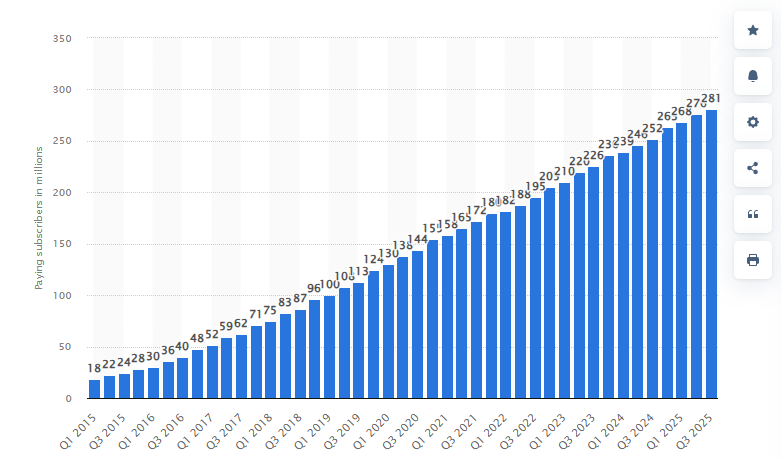
Premium subscribers? That’s where Spotify really earns its stripes.
Let’s see how this has changed over time.
Premium Subscribers (Annual)
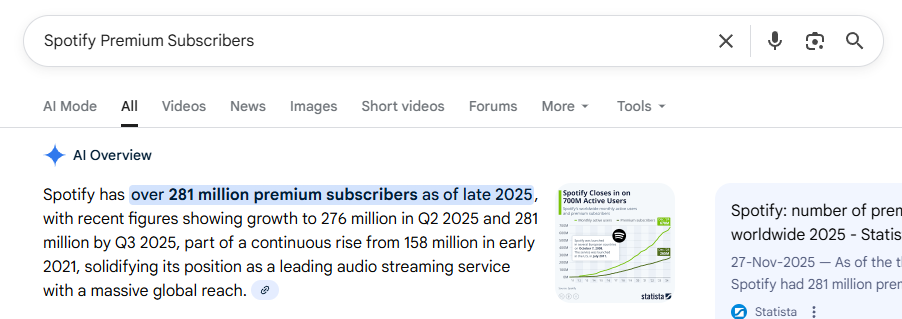
This isn’t about free listeners.
This is about people who choose to pay, month after month.
The chart below makes it easy to see how Spotify turned popularity into profit.
Premium subscribers are impressive, but I want to show you the bigger picture.
It’s one thing to see Spotify’s growth, but how does it compare to the rest of the streaming world?
Take a look at the table below, and you’ll see exactly who’s leading, who’s catching up, and where Spotify really stands.
Once you see this, you’ll get why the platform isn’t just popular, it’s dominating.
Spotify Market Share (Annual)
| Music Streaming Platform | Estimated Global Subscriber Share (Modeled Range) | Market Position Notes |
| Spotify | 31%–33% | Still the global leader with the widest device ecosystem + strongest discovery algorithms |
| Tencent Music Group (TME) | 14%–15% | Dominant in China through QQ Music, Kugou & Kuwo |
| Apple Music | 12%–13% | Strongest in US, UK, Japan — high-income premium demographic |
| Amazon Music | 10%–12% | Bundled with Prime drives large “silent subscriber” growth |
| YouTube Music | 9%–10% | Rapid growth due to short-form-to-streaming funnel from YouTube |
| NetEase Cloud Music | 6%–7% | China’s youth-centric, community-driven ecosystem |
| Yandex Music | 3%–4% | Regional leader in Russia & CIS markets |
| Deezer | 1%–2% | Smaller footprint but loyal user base in Europe & LATAM |
| Other Platforms | 9%–10% | Includes regional players like Anghami, Gaana, Boomplay |
Looking at the global numbers gives us the big picture, but it doesn’t tell the whole story.
Spotify might be dominating worldwide, but different regions have very different leaders and trends.
Let’s zoom in and see how Spotify performs across specific markets.
Chapter 3
Spotify Regional Market Share
This section is all about understanding where Spotify’s audience is strongest around the world.
In this section I’ll show you how Spotify’s market share differs by region and what those differences reveal about user behaviour and engagement.

Now that we’ve looked at the global picture, I want to show you something closer to home.
You might be surprised how differently people use Spotify depending on where they live.
They don’t all listen the same way. In some regions, people spend hours every day streaming, while in others, usage is shorter but still steady.
I researched different sources to get this data, and according to Backlinko, Coolest Gadgets, and others, the table below breaks down where Spotify’s Premium subscribers are and how much time they actually spend listening each day.
| Region | Share of Premium Subscribers | Average Daily Usage (Minutes) |
| Europe | 38% | ≈ 99 minutes/day (estimated) |
| North America | 27% | ≈ 140 minutes/day |
| Latin America | 22% | ≈ 117 minutes/day |
| Asia Pacific | 13% (part of “Rest of World” in some datasets) | ≈ 110 minutes/day |
| Middle East & Africa | Included under RoW (estimated 7–10%) | ≈ 124 minutes/day |
All that user activity is impressive, but there’s another side to the story.
I want to show you how Spotify turns engagement into serious revenue.
Spotify Annual Revenue Breakdown (2015–2025)
Let’s take a closer look at Spotify’s financial performance.
Subscribers are growing, listening time is climbing, and that momentum is showing up in their earnings.
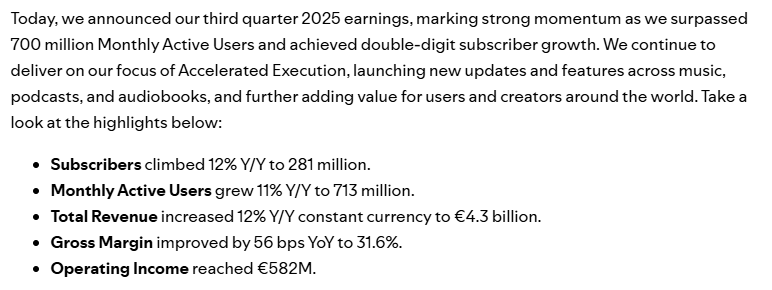
I went through their latest reports and pulled the key highlights so you can see exactly how the company is monetizing its massive user base.
Check out the screenshot below for the official numbers.
The numbers speak for themselves, but hearing it from the top gives you the real perspective.
Daniel Ek, Spotify’s Founder and CEO, breaks down exactly why this growth isn’t just a spike—it’s sustainable momentum.
His take highlights not just the revenue, but the strategy, the engagement, and the long-term vision behind it.
The business is healthy. We’re shipping faster than ever. And we have the tools we need – pricing, product innovation, operational leverage, and eventually the ads turnaround – to deliver both revenue growth and profit expansion,” said Daniel Ek, Spotify’s Founder and CEO.
Daniel talks about vision and strategy, but now let’s see the payoff.
Here’s how Spotify’s revenue has climbed year after year, turning millions of engaged users into billions in the bank.
| Year | Total Revenue | YoY Growth |
| 2015 | €1.94B | — |
| 2016 | €2.95B | +52% |
| 2017 | €4.09B | +39% |
| 2018 | €5.26B | +28% |
| 2019 | €6.76B | +28% |
| 2020 | €7.88B | +16% |
| 2021 | €9.67B | +23% |
| 2022 | €11.72B | +21% |
| 2023 | €13.23B | +12% |
| 2024 | €14.9B (estimate) | +13% |
| 2025 (Projected) | €17.2B (based on Q3 2025 run-rate) | +12% |
Revenue is climbing, but let’s be honest. Numbers only matter if you know how they compare.
So here’s the real question: who is actually winning the music streaming race in 2025 and who is falling behind?
I dug into the data and broke down Spotify versus its top competitors so you can see exactly where the power lies.
Chapter 4
Spotify vs Competitors (2025)
This section is all about comparing Spotify’s position against other major streaming platforms in 2025.
In this section I’ll show you how Spotify stacks up against competitors across users, growth, and overall market strength.

If you step back and look at music streaming in 2025, the picture sharpens quickly.
Spotify is not just leading. It’s operating at a scale no other platform publicly matches.
Right now, Spotify serves 713 million Monthly Active Users worldwide, with 11 percent year over year growth, according to its Q3 2025 earnings report. That alone puts it in a different category. Growth at this size is hard. Sustaining it is even harder.
But reach alone does not pay the bills.
Revenue does.
In Q3 2025, Spotify reported €4.3 billion in quarterly revenue, up 12 percent year over year in constant currency, with gross margins improving to 31.6 percent. That is not a vanity metric. That is proof that Spotify knows how to turn attention into income at scale. (Source: Spotify Investor Relations, Q3 2025)
What makes this more impressive is consistency.
Spotify’s annual revenue has grown from €1.94 billion in 2015 to an estimated €14.9 billion in 2024, with 2025 projected at €17.2 billion based on current run-rate data. That is a decade of compounding growth, not a short-term spike. (Source: Spotify Annual Reports, Statista)
Now compare that to the rest of the field.
Spotify holds an estimated 31 to 33 percent share of global music streaming subscribers, making it the clear market leader worldwide. Most other platforms dominate specific regions or grow through bundling, but none show the same combination of global reach, paid conversion, and transparent reporting. (Source: Statista, industry modeling reports)
This is where Spotify really separates itself.
You are not guessing with Spotify’s numbers.
You can track the users. You can track the revenue. You can track the growth.
Other platforms may claim rapid expansion or strong engagement, but without consistent, public global data, those claims stay hard to verify. Spotify, on the other hand, publishes its performance quarter after quarter and lets the numbers speak.
That is what dominance looks like in 2025.
Not hype.
Not selective stats.
Just scale, growth, and revenue that keep showing up.
So far, we’ve looked at what Spotify has already built.
The scale, the revenue, and the lead it holds today.
Now the more interesting question comes up.
Where does Spotify go next?
To answer that, we need to move from historical data to forward-looking signals.
Let’s look at what the trends suggest for Spotify in 2026.
Chapter 5
Spotify Trend Forecast 2026
This section is all about exploring where Spotify’s growth and strategy are heading next.
In this section I’ll break down key signals, market trends, and data points to forecast how Spotify could evolve in 2026.

Spotify isn’t just growing.
It’s dominating global music streaming.
By 2025, it had:
- 713 million monthly active users
- 281 million premium subscribers (Spotify Q3 2025 Earnings)
But the next big wave?
It’s not in Europe or North America.
It’s in Latin America, Asia-Pacific, and Africa.
Smartphones are everywhere. Mobile internet is cheap.
Spotify is ready to capture millions of first-time streamers.
By 2026, analysts expect 770–780 million MAUs.
Revenue is just as impressive.
$18.4 billion in subscription revenue.
Every feature—from offline downloads to AI DJ recommendations—keeps users listening longer and paying longer.
Ads aren’t just a side hustle. They’re a major growth engine:
- Programmatic audio ads
- Dynamic podcast ads
- Localized campaigns
Spotify could control 25–30% of global audio advertising spend (eMarketer, 2024).
Podcasts? That’s the secret weapon.
Revenue is projected to double by 2026, thanks to exclusive shows, subscription-only content, and AI-driven suggestions (Podcast Insights, 2024).
AI personalization isn’t a gimmick.
Discover Weekly, Daily Mix, AI DJ—all increase daily listening time by 15–20% (Spotify Tech Blog, 2024).
Even global economics can’t slow it down. Tiered pricing, family plans, student discounts—they keep growth moving. (Reuters, 2024)
By 2026, Spotify won’t just be bigger.It’ll be smarter, stickier, and more profitable, reshaping how the world consumes audio.